Daniel Anderson, PhD Associate Professor, MIT
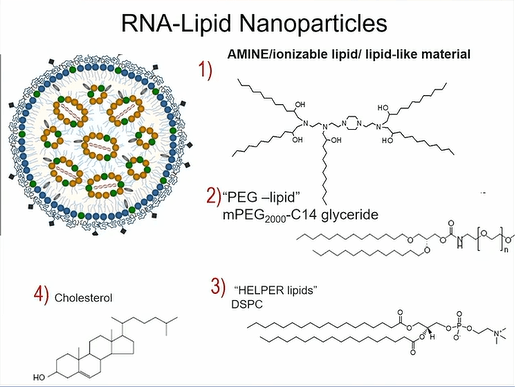
Dr. Daniel Anderson started his talk by discussing the first RNA nanoparticle developed by Alnylam which was approved for a liver disease by FDA in 2018. He presented some examples of FDA-approved lipid nanoparticles that share some compositional similarities. They are typically composed of four lipids and RNA which constitutes the workhorse of the RNA delivery. RNA-Lipid nanoparticles (LNPs) typically have an amine containing lipid or ionizable lipid as the most essential component. It serves as a method of complexing nucleic acids to self-assemble these nanoparticles and facilitate specific association with proteins that can take roles in certain tissue tropism and endosomal escape. Other components such as PEG lipids providing colloidal stability, phospholipids and cholesterol enhancing assembly and endosomal escape are also helpful.
Dr. Anderson also mentioned the challenges of RNA delivery. These molecules travel in bloodstream to reach target tissue while avoiding nontarget tissue. When they reach their target, they should enter cells through mechanisms like endocytosis and escape from endosome. However, there has been considerable progress in terms of delivery and targeting. The first point Dr. Anderson underlined is nanoparticle mediated RNA delivery is not limited to LNPs, vaccine applications, and targets such as liver.
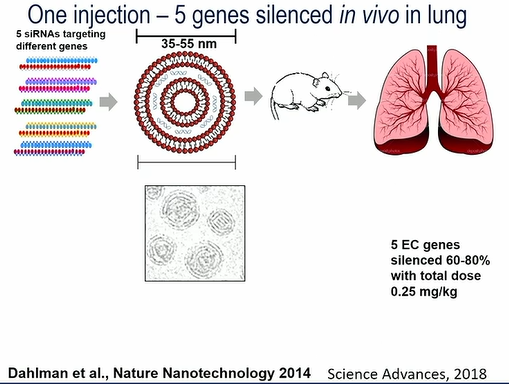
Polymer nanoparticles (PNPs) containing an amine containing polymer instead of ionizable lipid offer an alternative to LNPs. He shared a prior study published in Nature as an example of another organ targeted by LNPs. In the study, they injected PNPs containing five different siRNAs into mouse models to knockdown five corresponding genes. The study has indicated that it is possible to make a NP targeting lung rather than liver, and this technology is suitable for multiplexing. This leads to the concept that multiple RNAs interacting with multiple pathways could be effective in complex diseases such as cancer. He also shared example data from studies where leukocytes and stem cells have been targeted.
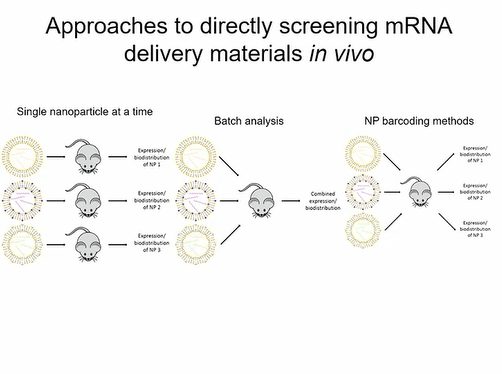
Dr. Anderson went on to discuss methods to identify good levels of RNA delivery. It is possible to inject one NP or multiple NPs at a time. A single NP system might be challenging when the number of NP to try is high and batch method requires narrowing down the candidates to identify which collection works better. However, NP barcoding methods use various NPs that were labeled at the same time. Although it is a powerful strategy to see where the different LNPs end up by looking at DNA barcodes, it does not solve main problems in the identification of the function of mRNA load because the final destination might not be where the optimal function is achieved. Therefore, they tried to develop a parallel barcode system to quantitatively measure different transcripts in a single animal by encoding different proteins in conjugation with different tags separated by a cleavage site. Following peptide cleavage, they analyzed LC-MS data to compare relative abundance. Dr. Anderson presented their data showing that there was a correlation between the amount of mRNA in LNPs and proteins expressed.
Following barcoding strategy, Dr. Anderson touched upon the strategies to increase the efficiency of RNA delivery systems by discussing the prior studies with different lipid structures such as DOTMA, DOTAP, etc. which differed by only a few atoms. Getting inspiration from the nature and prior literature, they have worked on combinatorial synthesis of lipid-like materials not requiring labor intensive processes such as protection, deprotection, and extensive purification. They made a library of 384 novel ionizable lipid formulations and demonstrated that some of those novel formulations achieved a couple fold better delivery performance than MC3 which is an example of early state-of-the-art in this area. They also showed similar efficiencies in the lung in spite of the challenging mucus layer.
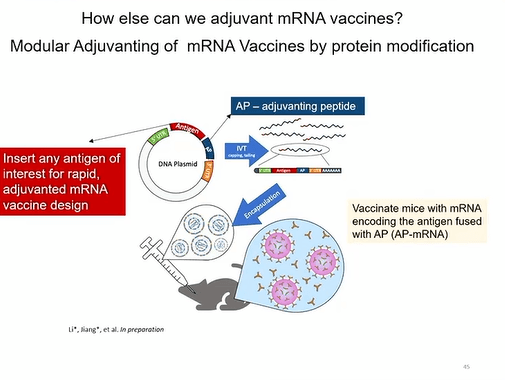
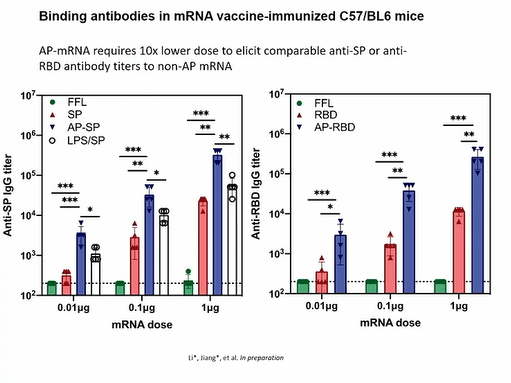
To conclude, Dr. Anderson underlined the high potential of RNA LNPs in genome editing and vaccine development. They delivered Cas9 mRNA using LNP and control AAV and indicated that non-viral delivery of Cas9 via LNPs were comparable to the best AAV mediated delivery system. He also mentioned the efficiency of nebulization as an alternative route to deliver mRNA NPs into the lung. These nebulized biodegradable LNPs performed better than the early polymer systems and displayed durable expression of mRNA in the lung. Dr. Anderson ended this talk with the potential of mRNA NPs in vaccine optimization. They again constructed a library of ionizable lipids, tested them and identified the ones displaying high levels of RNA delivery and expression. They noticed that the lipids themselves could act as adjuvants and Dr. Anderson explained this adjuvant effect by saying that some formulations could interact with stimulator of interferon genes (STING). They also discovered that the peptide sequence associated with the antigen of interest could improve immunogenicity. The peptides they called adjuvating peptide could be conjugated to any antigen and provided significant improvements in the overall antibody titers. He shared the data indicating that lower doses of antigens were required to elicit same level of antibody titers when they were conjugated to adjuvating peptides. Dr. Anderson concluded his talk by sharing that he was optimistic about the methods of adjuvating by either NP itself or with adjuvating peptide sequences to lower the doses of RNA needed and increase overall efficiency.